Spondylosis Treatment in Ayurveda: Natural Pain Relief for Neck & Back — Abu Dhabi, UAE
- What is spondylosis?
- Types: cervical, thoracic & lumbar
- Causes and risk factors
- Symptoms and warning signs
- How Ayurveda understands spondylosis
- Ayurvedic treatments for spondylosis
- Herbs used in treatment
- Diet and lifestyle for spine health
- Can Ayurveda help avoid surgery?
- Frequently asked questions
The spine is the structural foundation of everything you do — sit, stand, walk, turn your head, sleep. When it starts to degenerate, the consequences ripple through your entire daily life. A stiff neck that prevents you from checking your blind spot while driving. Lower back pain that makes it painful to stand through a 20-minute meeting. Arms that tingle and go numb while you're trying to concentrate on work.
These are the hallmarks of spondylosis — and they're increasingly common in the UAE, where long office hours, air-conditioned sedentary environments, screen-heavy lifestyles, and a high-heat climate all conspire to accelerate spinal degeneration. While the condition is often associated with aging, we see it regularly at our Ayurvedic medical center in Abu Dhabi in patients in their 30s and 40s, driven entirely by posture and lifestyle.
Conventional treatment focuses on pain management — anti-inflammatories, physiotherapy, and eventually surgery for severe cases. Ayurvedic treatment asks a different question: why is the spine degenerating in this person, and what can restore its health rather than simply muting its signals? This guide answers both questions thoroughly.
What Is Spondylosis?
Spondylosis is a broad term for degenerative changes in the spine that occur as discs, joints, ligaments, and vertebrae gradually wear over time. The spinal discs — gel-filled cushions between each vertebra — lose water content and elasticity as we age, reducing their shock-absorbing capacity. As degeneration progresses, bone spurs (osteophytes) can develop, joints become inflamed, and nearby nerves may become compressed.
The result is a spectrum of symptoms: from mild morning stiffness to chronic daily pain, from occasional tingling to persistent numbness radiating down the arms or legs. Severity varies enormously — and crucially, the structural changes visible on an MRI do not always correlate with symptom severity. This is one of the reasons Ayurveda's individualized approach is well-suited to spondylosis management.
The condition is sometimes confused with spondylitis (inflammatory) or spondylolisthesis (vertebral slippage). Spondylosis specifically refers to degenerative changes and is the most common of the three.
Types of Spondylosis: Cervical, Thoracic, and Lumbar
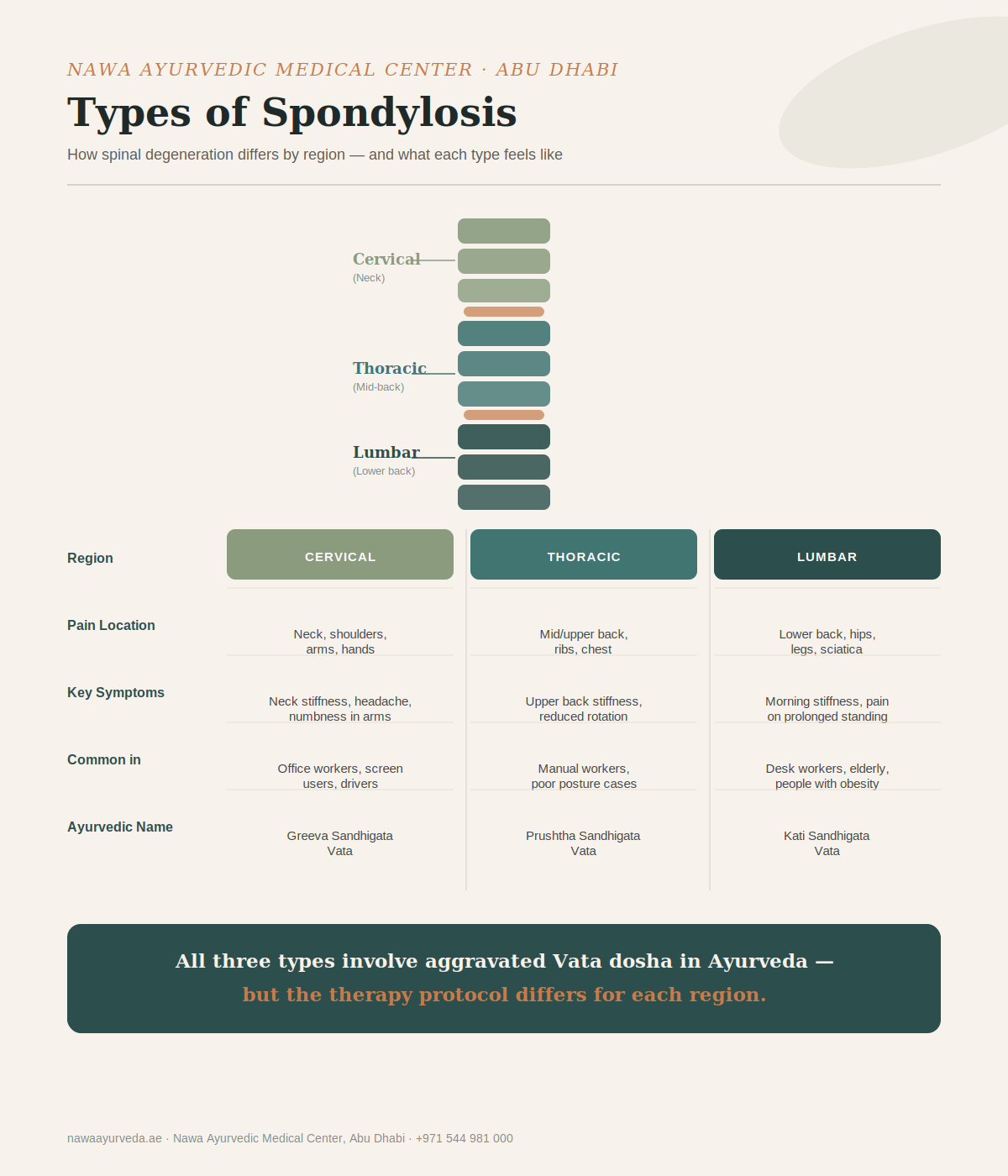
The location of degeneration determines which symptoms you experience and which Ayurvedic therapies will be most effective. This is why the therapy protocol differs between patients with neck pain and lower back pain, even though both conditions share the same root Ayurvedic imbalance.
Download this infographic
Cervical spondylosis (neck)
The most prevalent form, particularly among desk workers and anyone who spends extended time looking down at a screen or phone. Degeneration in the cervical (neck) vertebrae causes neck pain, stiffness, headaches, shoulder discomfort, dizziness, and — when nerve compression occurs — numbness or tingling that travels down into the arms and hands. In Ayurveda, this is called Greeva Sandhigata Vata.
Lumbar spondylosis (lower back)
Affects the lower spine (L1–L5), producing lower back pain, morning stiffness, muscle spasms, and pain that can radiate into the hips or down the legs in a pattern that resembles sciatica. Common in desk workers, anyone who lifts heavy loads, and people with obesity. The Ayurvedic term is Kati Sandhigata Vata.
Thoracic spondylosis (mid-back)
Less common because the thoracic spine is the most stable region — it is braced by the rib cage. When it does occur, symptoms include upper and mid-back stiffness, reduced ability to rotate the torso, and occasional chest or rib discomfort. Known in Ayurveda as Prushtha Sandhigata Vata.
| Feature | Cervical | Lumbar | Thoracic |
|---|---|---|---|
| Spine region | Neck (C1–C7) | Lower back (L1–L5) | Mid-back (T1–T12) |
| Key pain site | Neck, shoulders, arms | Lower back, hips, legs | Mid/upper back, ribs |
| Primary therapy | Greeva Basti, Ela Kizhi | Kati Basti, Njavara Kizhi | Abhyangam, Pizhichil |
| Ayurvedic term | Greeva Sandhigata Vata | Kati Sandhigata Vata | Prushtha Sandhigata Vata |
Causes and Risk Factors for Spondylosis
Aging is the primary risk factor — spinal discs naturally lose hydration and elasticity from your 30s onward. But several factors accelerate this process significantly, especially in the UAE context:
- Poor posture and screen habits — looking down at a phone or laptop for hours daily places 3–5x the normal load on cervical vertebrae
- Prolonged sitting — compresses lumbar discs continuously and reduces blood flow to spinal tissues
- Occupational strain — repetitive movements, heavy lifting, or constant vibration (driving, operating machinery)
- Obesity — excess weight significantly increases mechanical load on lumbar vertebrae
- Lack of physical activity — weak core and back muscles provide less support to the spine
- Spinal injuries — previous trauma accelerates degeneration in affected segments
- Genetics — family history influences disc resilience and joint health
- UAE-specific factors — extreme heat discourages outdoor activity; heavy air-conditioning creates cold-dry environments that aggravate Vata; long commutes promote prolonged sitting
Symptoms of Spondylosis and When to Seek Help
Early signs
- Morning stiffness that eases with movement
- Mild neck or lower back discomfort after long periods of sitting
- Reduced range of motion — difficulty turning the head fully
- Mild headaches originating from the base of the skull
Moderate symptoms
- Persistent daily neck or back pain
- Muscle weakness in the arms or legs
- Numbness or tingling in fingers, hands, or feet
- Pain that worsens with prolonged sitting, standing, or bending
- Difficulty maintaining good posture — the spine feels "unable to hold itself up"
Severe symptoms — seek medical evaluation promptly
- Loss of bladder or bowel control
- Significant weakness in limbs
- Sudden severe pain following a fall or injury
- Progressive numbness spreading down both legs
How Ayurveda Understands Spondylosis
In Ayurvedic medicine, spondylosis falls primarily under the category of Sandhigata Vata — a condition involving the vitiation of Vata dosha in the joints and bones (Asthi dhatu). Vata governs all movement in the body: nerve conduction, muscular contraction, fluid flow, and joint mobility. When Vata is aggravated and becomes lodged in the spinal joints, it produces the characteristic dryness, degeneration, stiffness, pain, and reduced mobility of spondylosis.
This aggravation rarely happens in isolation. The classical Ayurvedic texts identify three compounding factors:
- Asthi Dhatu Kshaya — progressive decline in bone and cartilage tissue quality, the structural equivalent of disc degeneration
- Ama accumulation — metabolic waste products from impaired digestion that deposit in spinal joints and obstruct normal tissue nourishment
- Vata-aggravating lifestyle — cold environments, irregular meals, late nights, excessive screen use, prolonged sitting, and stress all feed Vata imbalance directly
This framework explains something modern medicine has struggled to account for: why two people with apparently identical MRI findings can have completely different symptom experiences. Ayurveda's answer is that the body's inflammatory and tissue-repair environment — shaped by diet, lifestyle, and dosha balance — determines how severely those structural changes translate into pain and dysfunction.
Treatment, therefore, targets not just the affected spinal segment but the underlying Vata imbalance, Ama clearance, and tissue nourishment simultaneously — through Ayurvedic therapies tailored to each patient's constitution.
Ayurvedic Treatments for Spondylosis in Abu Dhabi
A personalized treatment plan at our Ayurvedic medical center in Abu Dhabi begins with a full consultation: dosha analysis, spinal assessment, lifestyle evaluation, and review of any existing diagnostic reports. No two protocols are identical — the therapies below are the primary tools, selected and sequenced based on your specific presentation.
Download this infographic
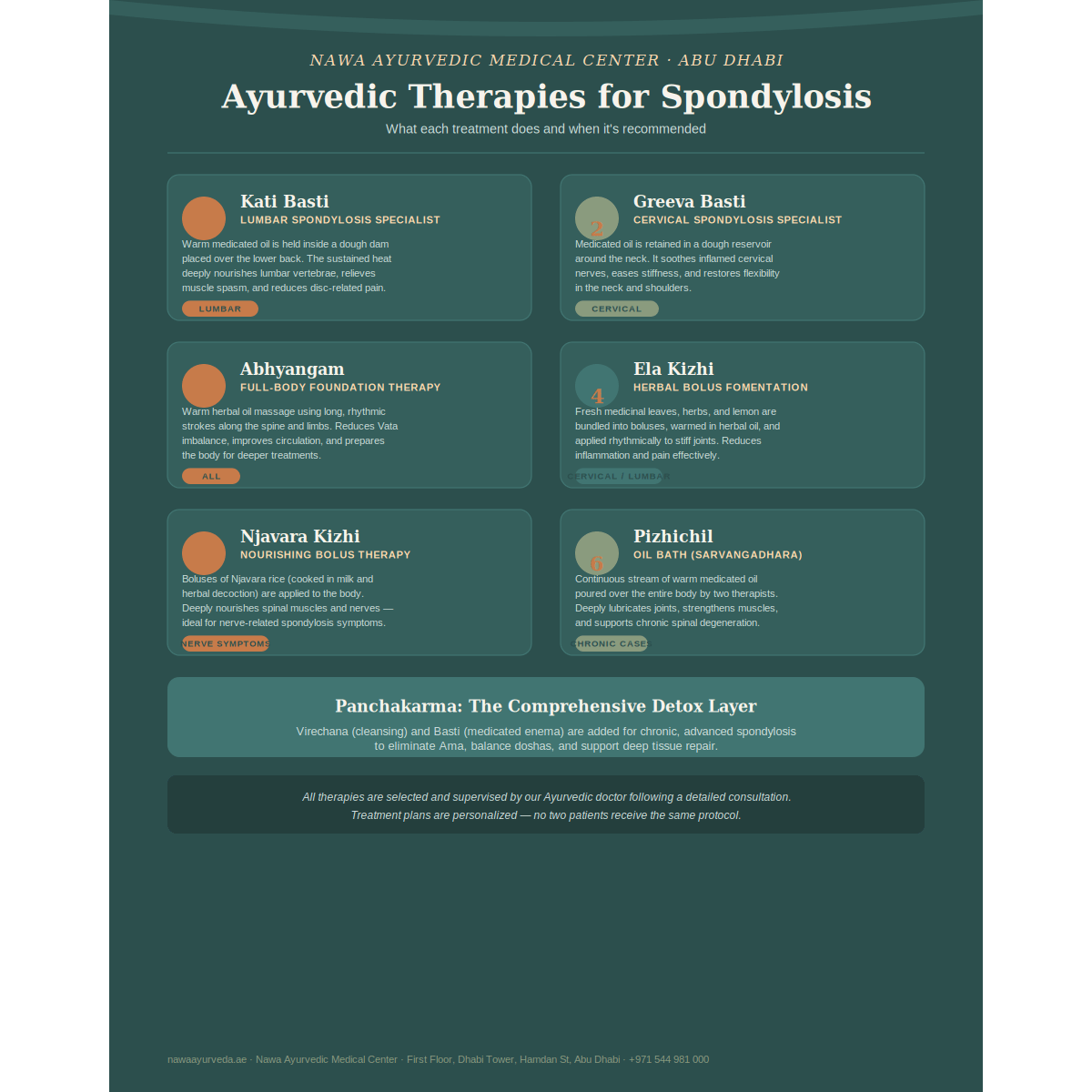
Kati Basti — for lumbar spondylosis
Warm medicated oil is retained inside a dough dam carefully shaped and placed over the lower back. The sustained, penetrating heat nourishes lumbar vertebrae and surrounding tissues, relieves muscle spasm, reduces inflammation in affected discs, and eases the radiating leg pain that often accompanies lumbar spondylosis. Sessions typically run 30–45 minutes.
Greeva Basti — for cervical spondylosis
The same technique applied to the neck region — a dough reservoir holds warm medicated oil over the cervical vertebrae. Particularly effective for reducing neck stiffness, headaches, and the shoulder and arm symptoms driven by cervical nerve compression. Many patients notice improved neck rotation range within 3–4 sessions.
Abhyangam (medicated oil massage)
A full-body warm herbal oil massage using firm, rhythmic strokes along the spine and limbs. Abhyangam directly reduces Vata imbalance, improves peripheral circulation, nourishes joint and muscle tissue, and prepares the body to receive deeper treatments. Used as both a standalone therapy and a preparatory step before Basti or Panchakarma procedures. Explore our full range of Ayurvedic therapies including Abhyangam.
Ela Kizhi (herbal bolus fomentation)
Fresh medicinal leaves — typically including nirgundi, drumstick, and other Vata-pacifying herbs — are combined with lemon and coconut, bundled into cloth boluses, warmed in herbal oil, and applied with rhythmic pressure to stiff joints and inflamed spinal segments. Highly effective for reducing local inflammation and breaking down Ama deposits in joint spaces.
Njavara Kizhi (nourishing bolus therapy)
Boluses of Njavara rice — a medicinal variety cooked in milk and a herbal decoction — are gently pressed over the spine and limbs. This is the most nourishing of the Kizhi therapies, specifically targeting Asthi dhatu (bone tissue) and nerve tissue. Particularly useful when nerve compression symptoms (numbness, tingling, weakness) are a significant part of the presentation.
Pizhichil (Sarvangadhara / oil bath)
A continuous stream of warm medicated oil is poured and simultaneously massaged over the entire body by two therapists working in unison. This deeply lubricates every joint, strengthens the muscles supporting the spine, and is one of the most powerful therapies for chronic, advanced spondylosis. It is typically recommended in later stages of a treatment program.
Panchakarma for spondylosis
For chronic or advanced cases, Panchakarma detoxification programs are used to clear systemic Ama and correct the deep dosha imbalance driving ongoing degeneration. The most relevant Panchakarma procedures for spondylosis are:
- Virechana (therapeutic purgation) — clears metabolic toxins and reduces Pitta-driven inflammation in joints
- Basti (medicated enema therapy) — the primary Panchakarma intervention for Vata disorders; directly addresses the root dosha imbalance in spondylosis
Looking for comprehensive programs?
Our structured Ayurvedic programs combine multiple therapies, herbal medicines, dietary coaching, and lifestyle guidance into a single, coordinated plan — ideal for patients with chronic or recurring spinal conditions. Our wellness treatments and stress relief therapies also complement spine care, since chronic stress is a significant Vata aggravator.
Ayurvedic Herbs Commonly Used for Spondylosis
Herbal medicines in Ayurveda are not standardized supplements — they are formulated for each patient's constitution and presentation. The following are the herbs most frequently incorporated into spondylosis treatment protocols:
- Ashwagandha (Withania somnifera) — supports nerve strength, reduces inflammation, and rebuilds depleted tissue (Asthi dhatu)
- Guggulu (Commiphora mukul) — particularly in its Yogaraj and Mahayogaraj formulations, used specifically for Vata-type joint and bone disorders
- Shallaki (Boswellia serrata) — supports healthy joint tissue and reduces inflammatory markers
- Rasna (Pluchea lanceolata) — classical Vata-pacifying herb used for joint stiffness and nerve-related pain
- Bala (Sida cordifolia) — nourishes nerve and muscle tissue; frequently used as a base for medicated oils applied in Basti therapies
- Nirgundi (Vitex negundo) — the primary herb in Ela Kizhi boluses; analgesic and anti-inflammatory properties in topical application
- Triphala — supports digestion and Ama clearance, addressing the metabolic root cause
Herbal medicines should only be prescribed following a proper Ayurvedic consultation. Dosage, formulation, and duration all depend on your individual dosha assessment and health status.
Diet and Daily Habits for Spondylosis Relief
Download this poster
Foods that support spinal health (Vata-pacifying)
- Warm, freshly cooked meals — cold, raw, and dry foods are the primary dietary drivers of Vata aggravation
- Ghee and healthy fats — nourish bone tissue and lubricate joints
- Sesame seeds and sesame oil — specifically indicated for Asthi dhatu support in classical texts
- Whole grains — wheat, rice, oats; easily digestible and grounding
- Root vegetables — sweet potato, carrots, beetroot; nourishing and Vata-pacifying
- Warm herbal drinks — ginger tea, turmeric milk, ashwagandha milk
- Nuts and seeds — almonds, walnuts, pumpkin seeds in moderation
Foods to avoid or minimize
- Processed and packaged foods (cold, dry, and Vata-aggravating)
- Cold drinks, carbonated beverages, and ice
- Excessive caffeine and alcohol (dehydrating)
- Deep-fried and heavy foods (Ama-forming)
- Raw salads eaten cold, especially in the evening
- Highly refined sugars
Lifestyle modifications
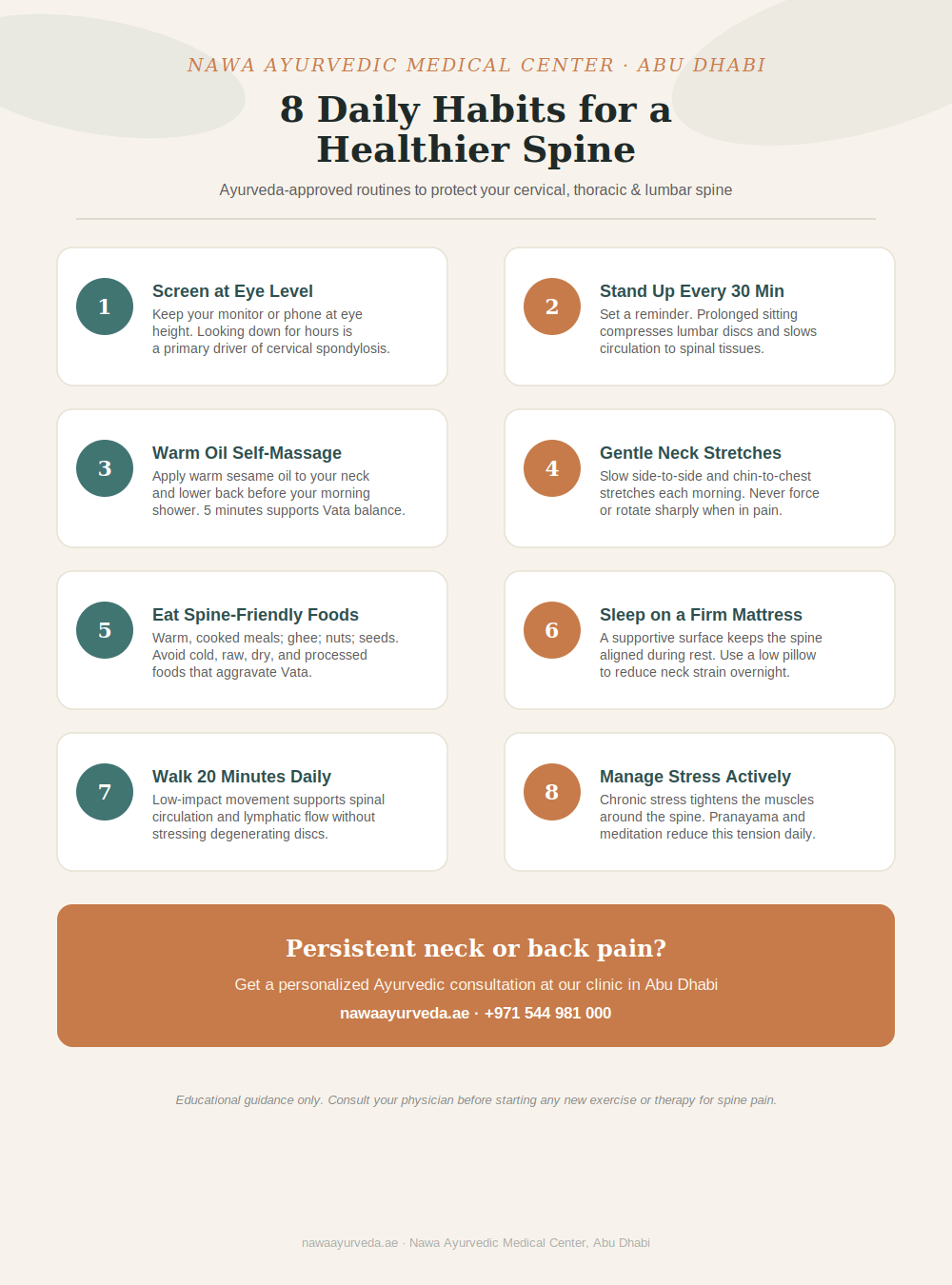
- Ergonomic workspace setup — monitor at eye level, chair supporting lumbar curve, screen no closer than arm's length
- Movement every 30 minutes — set a timer; stand, walk briefly, or stretch
- Daily walking — 20–30 minutes of low-impact walking supports spinal circulation without compressive stress
- Warm sesame oil self-massage — 5–10 minutes on the neck and lower back before your morning shower
- Yoga & stretching — poses recommended specifically for spondylosis should be guided by a qualified instructor; avoid deep forward bends and unsupported twists during acute pain
- Sleep position — firm mattress, low pillow for cervical cases; side sleeping with a pillow between the knees for lumbar cases
- Stress management — pranayama and meditation reduce Vata aggravation directly; explore our Ease Your Mind treatments for integrated stress relief
Can Ayurveda Help Avoid Spinal Surgery?
This is one of the most common questions at our Ayurvedic medical center in Abu Dhabi. The honest answer is: often yes, sometimes no, and always early treatment gives the best odds.
For mild-to-moderate spondylosis — the vast majority of cases — Ayurvedic treatment can meaningfully reduce pain, restore mobility, slow degeneration, and improve quality of life without surgery. Many patients who come to us already scheduled for disc-related procedures experience enough improvement to defer or avoid surgery entirely.
For severe cases involving significant structural nerve compression, spinal instability, or progressive neurological deterioration (weakness, bowel/bladder changes), surgery remains the appropriate primary intervention. Ayurveda can still play a supportive role in recovery and in preventing recurrence, but it should not replace or delay medically necessary surgical treatment.
The honest conversation about whether your case is a good candidate for conservative Ayurvedic management happens in your consultation — not in a blog post. Contact us to book an assessment.
Why Choose Nawa Ayurvedic Medical Center for Spondylosis Treatment?
- Detailed initial consultation — every treatment plan begins with a full assessment, not a generic protocol
- Authentic Kerala Ayurvedic therapies — Kati Basti, Greeva Basti, Ela Kizhi, Njavara Kizhi, Pizhichil, and Panchakarma administered correctly
- Personalized herbal medicines — formulated for your dosha type and symptom pattern
- Integrated approach — therapy, diet coaching, and lifestyle guidance in a single plan
- Trusted Ayurvedic medical center in Abu Dhabi — serving the UAE community with 16+ years of combined experience
- Accessible location — First Floor, Room 103, Dhabi Tower, Hamdan Bin Mohammed St, Abu Dhabi, open 7 days, 8am–10pm
Read what patients say about their experience on our reviews page, or browse our full services list to understand the range of treatments available.
Book Your Spondylosis Consultation in Abu Dhabi
Get a personalized Ayurvedic assessment and treatment plan for cervical or lumbar spondylosis, chronic back pain, or neck stiffness — natural, non-invasive, and tailored to you.
Open 7 days · 8am–10pm · +971 544 981 000
Book Your AppointmentFrequently Asked Questions
Manage Spondylosis Naturally with Ayurveda
Spondylosis is progressive — but it is not inevitable that it will progressively worsen. With the right combination of Ayurvedic therapy, diet, posture correction, and lifestyle change, many patients experience genuine, sustained relief and a meaningful slowdown of degeneration. The key is early, consistent, personalized care — not waiting until symptoms become severe enough to consider surgery.
At Nawa Ayurvedic Medical Center, Abu Dhabi's trusted Ayurvedic clinic, we see the difference that a well-designed, individualized treatment plan makes every day. Whether you are dealing with neck stiffness from years of screen work, lower back pain from a desk job, or chronic spinal discomfort that has not responded to conventional management, there is almost certainly a better path forward through Ayurveda.